
What is Closed-Loop Manufacturing?
TALK WITH OUR EXPERTSClosed-loop manufacturing is a method of controlling a production process in which part measurements are automatically converted into machine corrections. The part is measured, the necessary adjustments are calculated, and they are applied to the machine, closing the loop between measurement and production.
It builds on SPC (Statistical Process Control) but goes one step further: instead of merely detecting when a process drifts, it calculates and applies the correction. Clooma’s approach was developed based on the research of Professor Maurice Pillet and the SYMME laboratory at the University of Savoie Mont Blanc in France.
In machining, closed-loop manufacturing is based on two principles:
- Managing complex processes, by managing the simultaneous correction of dozens of tool offsets
- Correcting process drift, through damping functions that respond to actual drift, not to normal variation
Closed-loop manufacturing: three meanings, one focus
The term «closed-loop manufacturing» is used in several contexts:
- Circular economy: reusing scrap and end-of-life products as raw materials.
- Product lifecycle management: incorporating production and field data into product design.
- Process control: feeding measurement data back into the machine settings during production.
This article focuses on the third meaning, as it applies to precision machining, where closed-loop control directly reduces scrap and setup time.
How does closed-loop manufacturing work in machining?
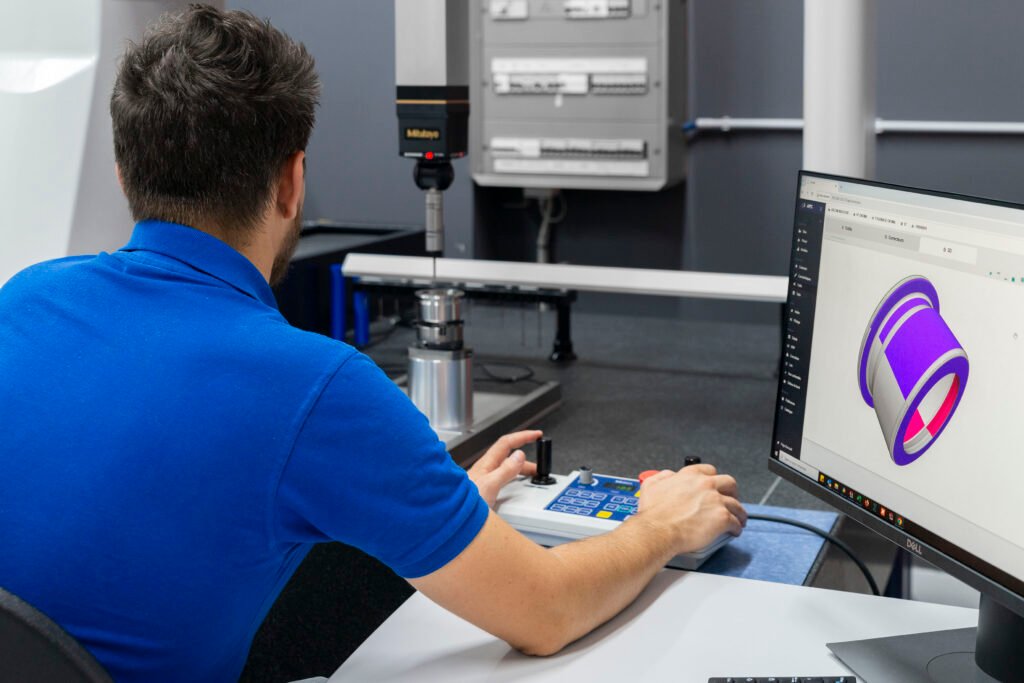
In a machine shop, closed-loop manufacturing operates as a simple cycle:
- Measure. The operator measures one or more parts using the shop's measuring equipment.
- Calculate. The software analyzes the results against the tolerances and the process history, and calculates the necessary adjustments.
- Correct. The tool offsets are sent back to the CNC without any manual calculation or entry.
The operator no longer has to figure out which offsets to change or by how much. The software does it consistently, every shift.
Principle 1: Controlling Complex Processes
Why is manual adjustment so difficult?
On complex parts, dimensions are interdependent: changing one tool offset affects several characteristics at once. Setting up the machine quickly becomes a puzzle.
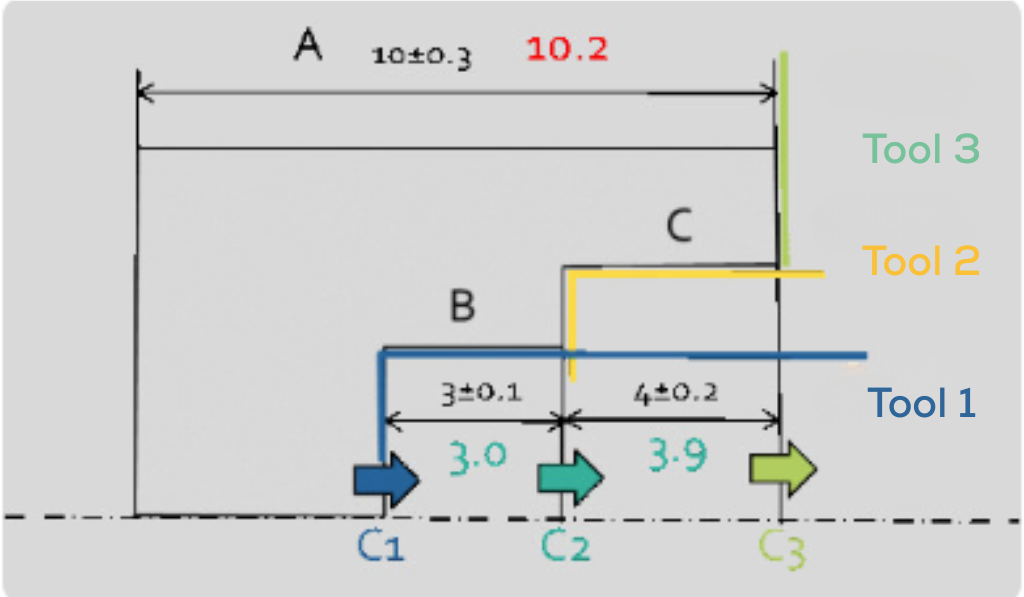
Consider the example above. Dimension A It measures 10.2 and is out of tolerance. To correct this, you need to adjust the tool T3. But T3 also affects the dimension C, which is currently within tolerance. So you must also adjust the tool T2, which in turn affects the dimension Band so on.
The operator now has to figure out how to adjust T1, T2 and T3 work together to bring A back into compliance without pushing B or C out of compliance.
This example is simple. Real parts often have dozens of characteristics and tools, and determining the right combination by hand can take a significant amount of time and carry a high risk of error.
How does Clooma calculate the optimal adjustment?
Closed-loop manufacturing software such as Clooma automatically calculates the optimal adjustment for each tool. It uses a configuration that can be set up in two ways:
- based on the individual impact of each tool, or
- from a 3D measurement file of the part.
From the individual impact of each tool
Configuring Clooma involves defining how each tool offset affects the measured characteristics. The question to ask is simple: If I change this offset, which dimensions will move?
This is done only once, when the part is put into production. From then on, Clooma’s algorithms automatically calculate the required adjustment for each tool. For example:
T1: -0.3 mm · T2: -0.3 mm · T3: -0.2 mm
From a 3D measurement file
Setup is even simpler with a 3D measurement file. You import the file and specify the types of corrections the machine uses. Clooma’s algorithms handle the rest and calculate the optimal settings.
Whichever method you choose, the result is the same: the operator no longer has to perform any manual calculations. The necessary adjustments are made automatically.
Principle 2: Correcting Process Drift
The limits of SPC (Statistical Process Control)
With SPC, control charts are used to monitor variation. The process is considered stable as long as the measurements remain within the control limits. When a data point falls outside the control limits, the process has drifted and must be adjusted.
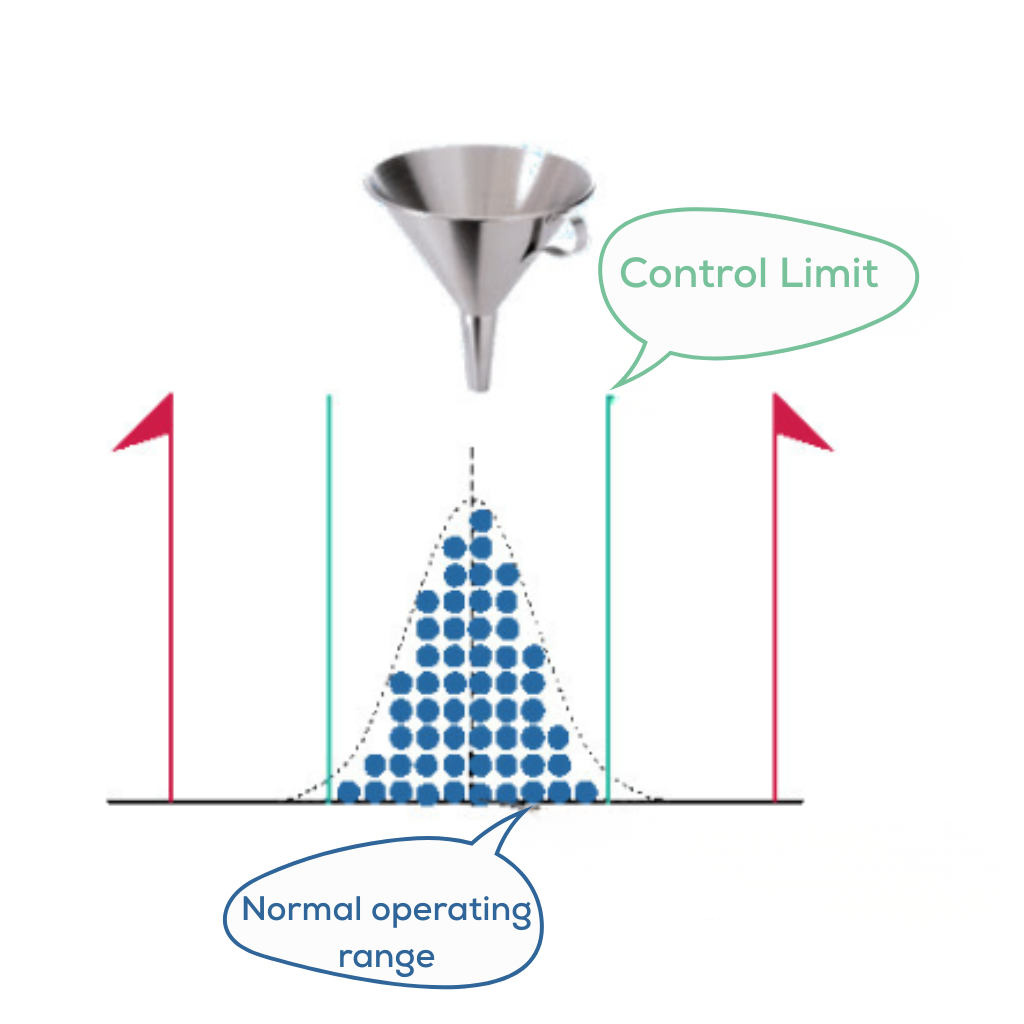
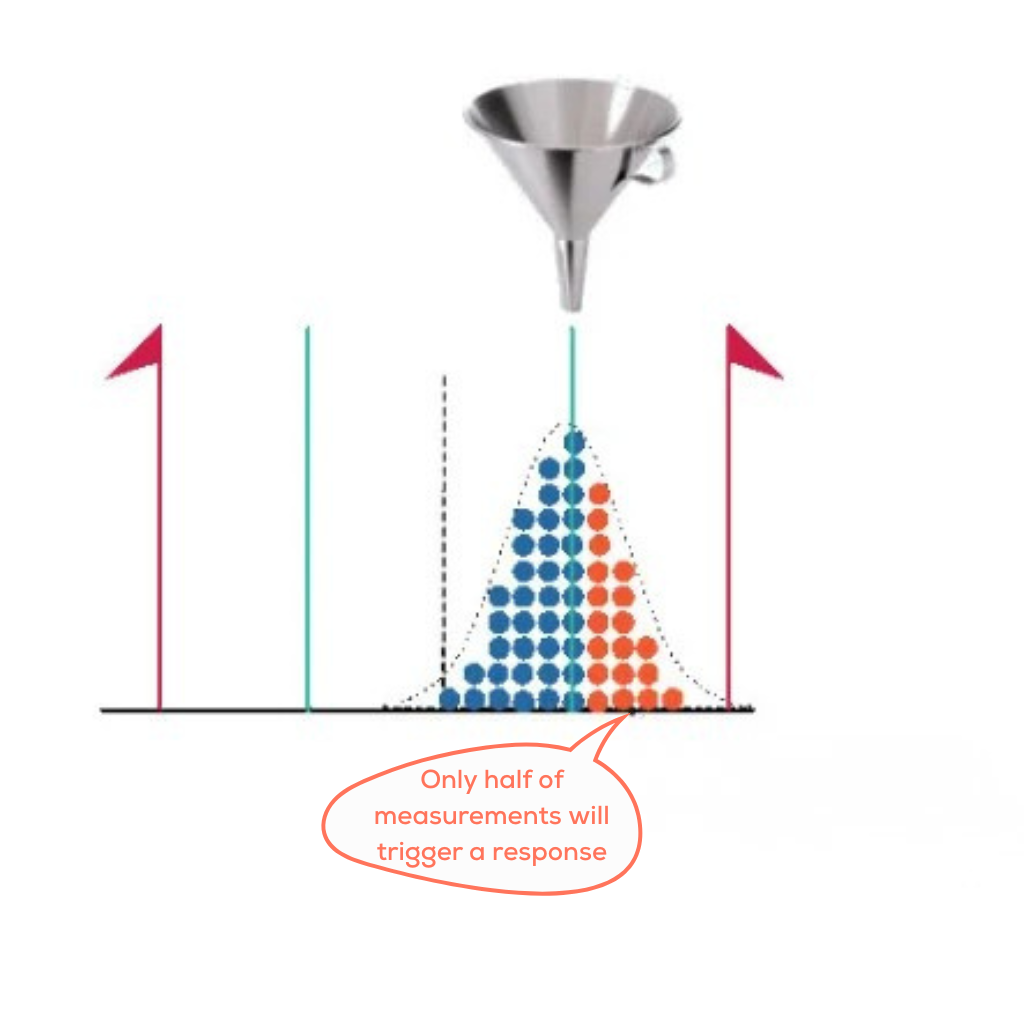
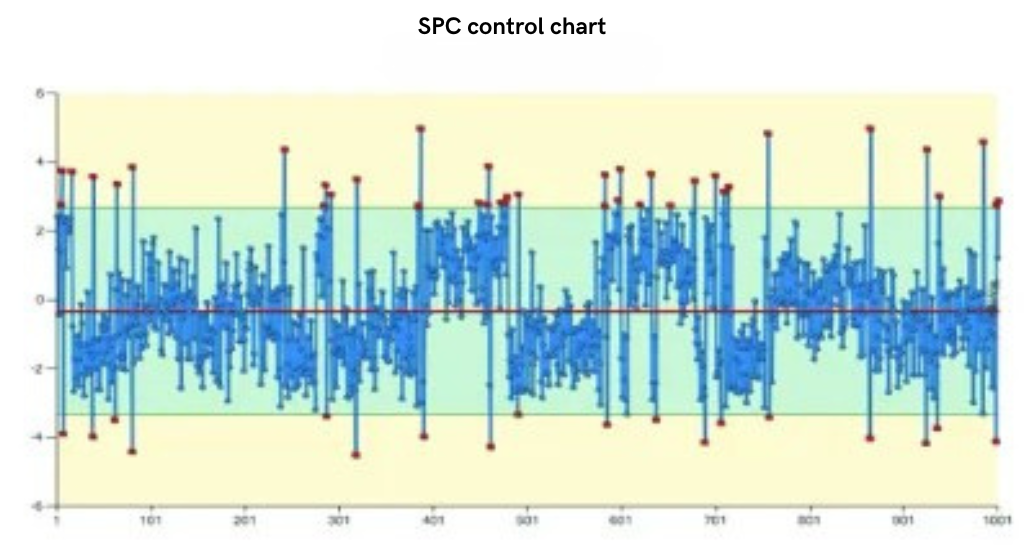
The problem is that SPC only reacts once the process has already drifted significantly. In the example below, the process has clearly begun to drift, yet only about half of the measurements fall outside the limits. By the time corrective action is triggered, it is already too late.
How Damping Functions Correct Drift
SPC operates on a binary logic: either within or outside the limits. Digitally calculating adjustments allows for much finer control.
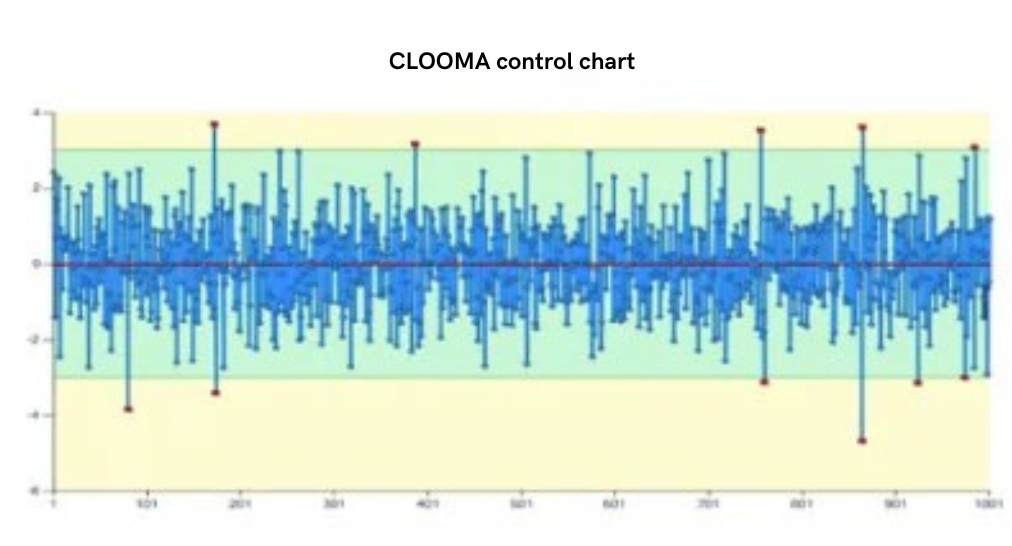
With Clooma, the process is evaluated at every measurement. The software calculates a correction proportional to the drift, weighing each new result against the process history. Small random variations are suppressed rather than tracked, while actual drift is corrected well before it reaches the tolerance limits.
The two charts below show the same process, first monitored using traditional SPC, then corrected using Clooma.
Process monitored with traditional SPC :
Same process monitored with CLOOMA software :
Benefits of Closed-Loop Manufacturing
Compared with traditional process control, closed-loop manufacturing:
- Reduces the setup to a single part. With automated adjustment, a single part is all that is needed to set up the machine. For example, a gearbox housing that used to take half a day to set up can now be adjusted in about 30 minutes—a single production cycle.
- Scrap cuts. Fewer setup parts and fewer parts that fall outside tolerance limits in production. LISI, for example, reduced its scrap rate by 95%.
- Improves process capability. Ppk values above 1.33 for critical characteristics become achievable.
- Handles complexity. Dozens, even hundreds, of characteristics are monitored simultaneously, and the relationships between offsets are calculated automatically.
- Eliminates human error. No more calculation or sign errors, and the same adjustment logic for every shift and team.
- Is quick to adopt. Operators can be trained in a single day.
Conclusion
By automating process adjustments, closed-loop manufacturing achieves quality levels that manual methods and traditional SPC cannot match, while freeing up machine time previously lost to setups and corrections.
Clooma was built from the ground up based on these principles. Whether you need to control a complex part or keep a fluctuating process within tolerance, it relieves the operator of the burden of calculations and brings a new approach to process control to your shop floor.
Do you have any more questions?
Read our FAQ or see the LISI Case Study.
Let's talk about your factory